The job description is one of the most useful preparation tools available to you before an interview. Most candidates read it once to understand what the role involves and then set it aside.
That is a missed opportunity.
A job description is effectively a preview of what the interviewer cares about most. When you learn to read it that way, you can predict a significant proportion of the questions you will face and prepare answers that land precisely because they address the employer's actual priorities.
What a job description is really telling you
A job description is written by the hiring team to describe the ideal candidate. Every section contains useful signals:
Core responsibilities show what you will be expected to do day-to-day. These translate directly into likely questions: "Tell me about your experience managing X" or "Give me an example of when you have done Y."
Required skills and qualifications tell you which capabilities the employer considers non-negotiable. Prepare evidence for each one.
Repeated keywords reveal priorities. If the words "stakeholder management," "data-driven," or "cross-functional collaboration" appear more than once, they are not accidental. They are things the interviewer will probe.
Tools and domain knowledge flag areas where you may be asked to demonstrate technical competence or practical familiarity.
Leadership expectations signal the seniority and autonomy of the role. A phrase like "lead without direct authority" tells you they will test influence and communication skills.
Culture and values language gives you clues about the kind of person they are looking for beyond the technical requirements.
A practical process for analysing the job description
Step 1: Read it twice before doing anything else
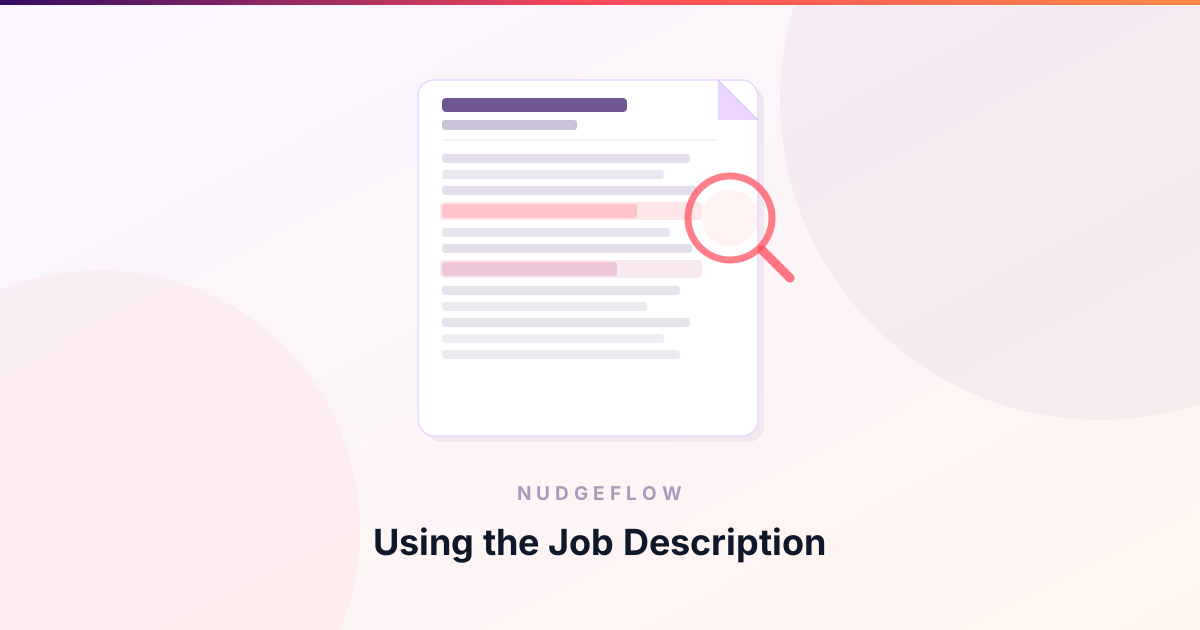
Read it once for general understanding. Read it a second time with a highlighter, marking anything that describes a skill, responsibility, or quality they seem to value.
Step 2: Extract the top five to seven priorities
Not everything in a job description carries equal weight. Identify the handful of capabilities that appear most prominently or are listed under essential criteria. These are your preparation anchors.
Step 3: Map your experience to each priority
For each priority, ask yourself: "What is my strongest example of demonstrating this?" Write down one or two stories for each. These become the foundation of your interview preparation.
If you find a priority where you have a genuine gap, prepare an honest answer that acknowledges it and explains how you are developing in that area. Interviewers respect self-awareness more than overconfidence.
Step 4: Predict the likely questions
Turn each priority into a question the interviewer might ask. For example:
- "Leads cross-functional teams" → "Tell me about a time you worked with teams across different departments."
- "Data-driven decision-making" → "Give me an example of a decision you made based on data."
- "Commercial awareness" → "Tell me about a time you had to balance quality with commercial constraints."
You are not trying to predict every question — you are ensuring you have strong examples ready for the themes most likely to come up.
Step 5: Tailor your opening answer
Your "Tell me about yourself" answer should reflect the priorities you have identified. The skills and experience you emphasise should be the ones most relevant to what the employer needs.
The question most candidates overlook
Almost every job description contains clues about why the role is difficult or what the previous person in the role may have struggled with. Phrases like "fast-paced environment," "high-volume workload," or "complex stakeholder landscape" are signals worth noting.
Understanding the challenges inherent in the role helps you demonstrate that you understand what you are walking into — which is itself a mark of strong candidates.
Practise with the job description in front of you
Reading the job description is preparation for the preparation. The real value comes from practising your answers against the questions it implies.
Nudgeflow lets you generate interview questions from a job description and practise your answers in a realistic mock interview. You can work through the questions most likely to come up for your specific role and get feedback on whether your answers address what the employer is actually looking for.
Frequently asked questions
How early should I start analysing the job description? As soon as you book the interview. The more time you have to prepare specific examples, the more confident your answers will be.
What if the job description is vague or very short? Look at similar roles in the same industry to identify common competencies. You can also research the company and try to understand what they value from their website, recent news, or employee reviews.
Should I mention the job description in the interview? You can reference it naturally — for example, "I noticed the role involves a lot of stakeholder communication, which is something I have done extensively in my current role." This signals preparation and genuine interest.
What if my experience does not match all the requirements? Focus on the areas where you do have strong evidence and be honest about gaps while showing how you are addressing them. No candidate matches every requirement perfectly.
Can I ask about the job description at the end of the interview? Yes. Asking a thoughtful question about the role — informed by the job description — is a strong closing move. It demonstrates genuine interest and careful preparation.